
Projects

Tile delamination detection on building façades using drone infrared thermography
Source: ITF
In Hong Kong, most buildings approaching 30 years of service, tile delamination due to infrastructure deterioration is a significant concern. The goal of this project is to detect tile delamination on building facades using an infrared thermography-based method and UAV-captured IR images. To achieve this, a comprehensive database will be established through controlled delamination defect testing and on-site facade inspection. Additionally, a rapid defect identification algorithm will be developed based on machine learning. This project is expected to quickly detect delamination on infrastructure and buildings, in order to prevent falling objects from heights that could pose a danger to public safety.
To address imperfect synchronization between the visual and IR cameras on commercial unmanned aerial vehicles, we developed a multimodal feature description network to register RGB–IR image pairs. Code and dataset are available here.
To more effectively integrate RGB–IR information and accommodate modality-specific characteristics (e.g., spalling is prominent in both modalities, whereas delamination is primarily visible in IR), we developed the Layered Bilateral Feature Fusion Network for efficient RGB–IR fusion. The code and dataset are publicly available.




Collaborator: RaSpect
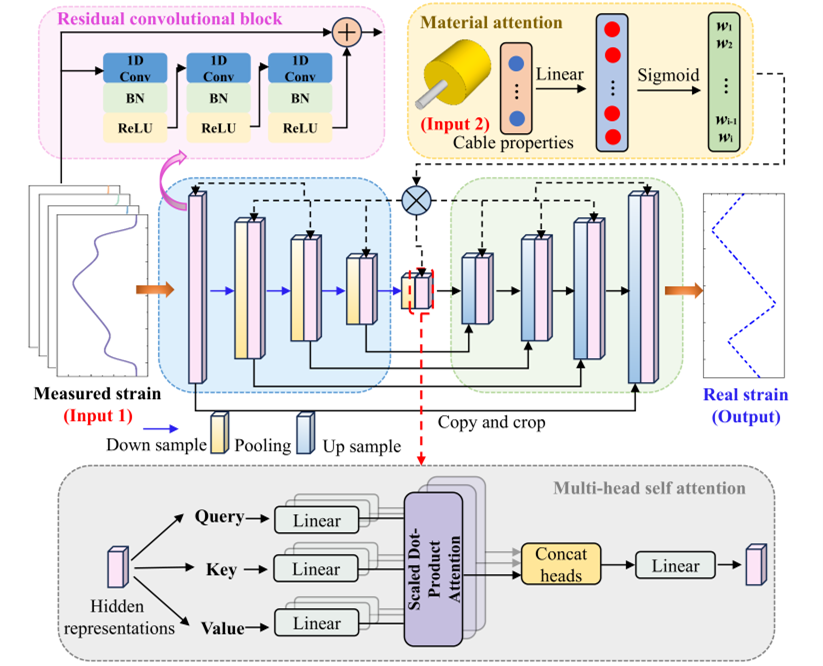
Strain Field Reconstruction and Crack Quantification Using Distributed Fiber Optic Sensing
Distributed fiber optic sensing (DFOS) enables continuous measurement of strain distributions along sensing fibers, offering a promising approach for strain monitoring and crack quantification in structures. In this project, we proposed an integrated analytical and deep learning-based framework to reconstruct the real strain field and quantify the damage of structures based on DFOS measurements.
Strain field reconstruction: We built a dual-path (forward + inverse) framework to understand DFOS measurement accuracy under strain gradients and discontinuities, and to reconstruct the host-material strain field using deep learning approach. (Reference [1])
Crack quantification with opening direction: Crack opening direction can bias DFOS-based crack width estimates. We developed two complementary methods—one using the strain-profile shape and the other using fiber elongation—to estimate both crack width and opening direction. (Reference [2])
Multiple cracks with overlapping peaks: For multi cracking scenarios where strain peaks overlap, we developed a deep learning model to detect and quantify multiple cracks, and to infer key cable structural parameters of the optical fiber sensor. (Reference [3])
- [1] Xuanyi Lu, Sudao He, Shenghan Zhang. Reconstruction of host matrix strain field from distributed fiber optic sensing: deep learning based approach addressing strain transfer effects. Engineering Structures 2026; 353:122181.
- [2] Xuanyi Lu, Shenghan Zhang. Investigation of crack quantification using distributed fiber optic sensors Considering crack angles. Structural Health Monitoring 2025.
- [3] Xuanyi Lu, Sudao He, Shenghan Zhang. Reconstruction of host matrix strain field from distributed fiber optic sensing: deep learning based approach addressing strain transfer effects. Engineering Structures 2026; 353:122181.

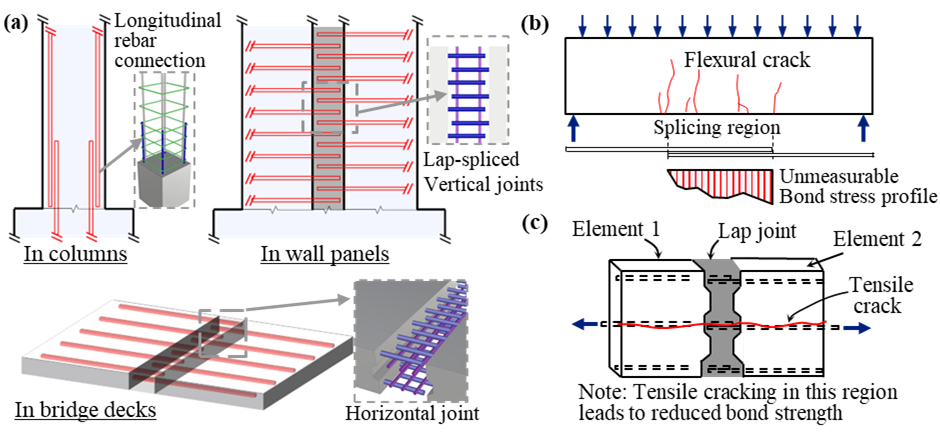
Unveiling local bond stress transfer in lap splices via distributed fibre optic sensing and rib-scale modelling
Lap splices are critical for establishing structural continuity in reinforced concrete elements, yet their unique local bonding behaviour significantly influences member stiffness and ductility. This study investigates the tensile behaviour of double-row lap splices in normal-strength concrete through direct tension tests on five specimens, focusing on the effects of lap length and clear spacing. Digital Image Correlation (DIC) was employed to analyse surface cracking and failure modes, while Distributed Fibre Optic Sensors (DFOSs) embedded along the rebar ribs provided high-resolution strain distributions to deduce local bond stress evolution. The experimental results revealed that while increasing lap length shifted the failure mode from splitting-pullout to bar yielding, the behaviour of contact splices deviated from theoretical expectations; unlike non-contact splices, where a small clear gap facilitates concrete consolidation and bond development, contact splices suffered from consolidation defects that compromised bond strength. A refined 3D finite element model, incorporating explicitly modelled rib-scale mechanical interlocking, was developed to simulate interfacial stress transfer. The model successfully elucidated the internal force transfer mechanism, confirming that force transfer between lapped bars is governed by diagonal concrete strut action. Furthermore, bar-scale simulations utilizing fib Model Code 2020 bond–slip laws were benchmarked against the rib-scale model to evaluate their predictive accuracy for confined splices. These findings advance the mechanistic understanding of contact and non-contact splices and provide evidence to inform detailing choices in precast and cast-in-place construction.

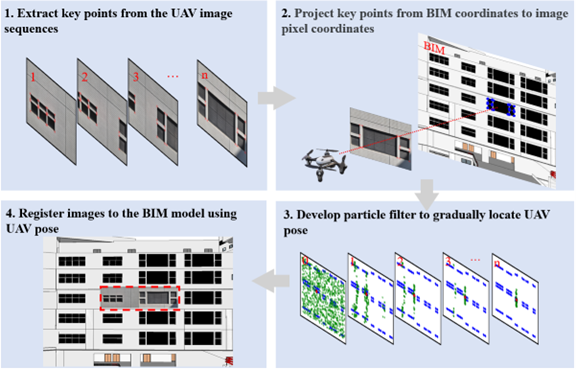
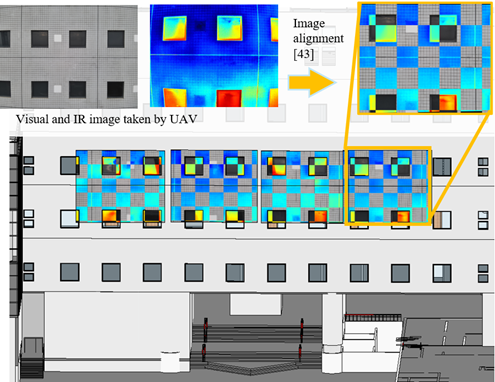
GPS-Free Automated Registration of UAV-Captured Façade Image Sequences to BIM Using Semantic Key Points
Unmanned Aerial Vehicles (UAVs) have emerged as essential tools for building façade inspection. However, due to the repeating patterns on façades, automatically registering images taken by UAV to Building Information Modeling (BIM) models, though important for building maintenance, remains challenging. Existing methods often rely on GPS data, which lack sufficient accuracy in urban environments. This paper proposes a GPS-free automated framework to register UAV-captured image sequences to BIM models by leveraging information from overlapping images. The framework comprises three key components: (1) extracting semantic key points from images using the Grounded SAM 2; (2) implementing a virtual UAV camera model to enable bidirectional projection of key points between BIM coordinates and image coordinates; and (3) developing a particle filter motion model to achieve image-to-BIM registration using image sequences. The proposed method registers various data types to BIM models, including overlapping visual image sequences, infrared (IR)-visual pairs, and façade defects.

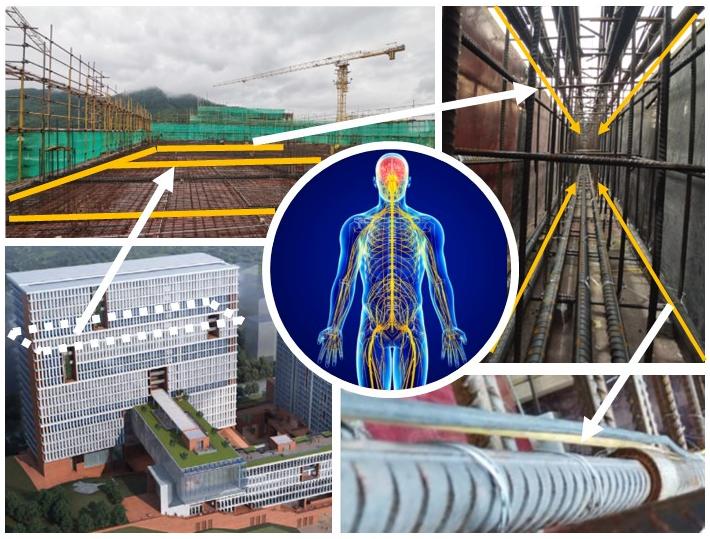
Intelligent building monitoring with distributed fiber optic sensing
Distributed fiber optic sensing technology provides a unique opportunity to build the nervous system of for infrastructure. The project leverages the unique capabilities of fiber optic sensors to monitor various building parameters such as temperature, strain, and vibration, with high accuracy and reliability. The system is designed to provide early warning of potential issues, and to improve the building’s operational efficiency. This project has significant potential to contribute to the field of building monitoring and maintenance, and its outcomes could have a positive impact on the safety, sustainability, and longevity of buildings.
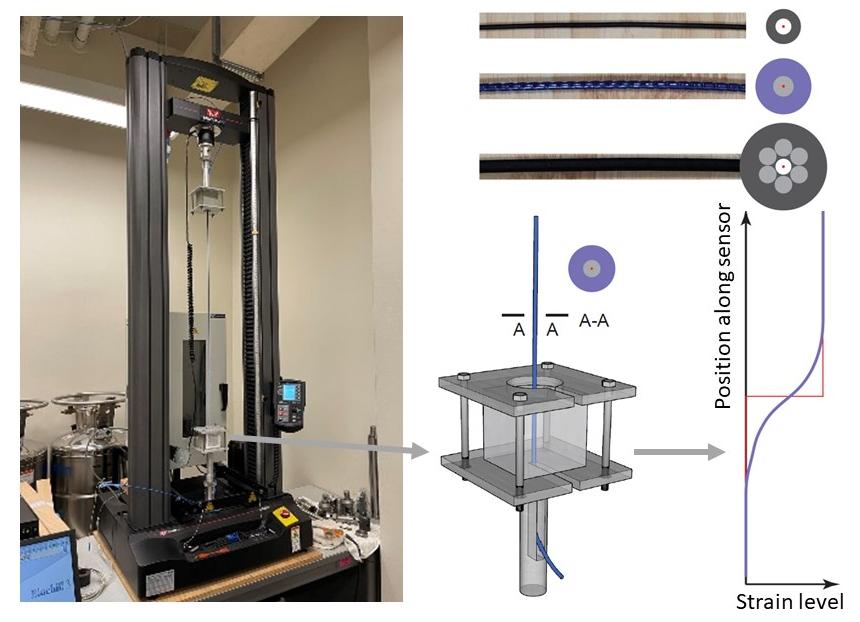
Strain transfer mechanism of fiber optic sensors
Understanding the mechanical behavior of fiber optic deformation is critical for interpretation of distributed fiber optic sensing results. The project involves conducting experiments, numerical simulations, and analytical investigations to study the deformation fiber optic sensor behavior under different loading conditions and analyzing the results to understand the underlying mechanisms of strain transfer. The outcomes of the project will help to improve the accuracy and reliability of fiber optic sensors by providing insights into their deformation behavior and the factors that affect their performance.